

And like I said at the Health Connect Partners event in May (to a room full of chuckles), formulary excites me. 😀 If you don’t believe me, here’s proof...
Why is there a growing interest in what for many years has felt like white noise in healthcare operations? Consolidation is the answer.
If you've been in health system pharmacy for a while, you have probably already felt the renewed urgency around formulary management, which hasn't been this palpable since the Affordable Care Act was pushing health systems to think differently about how they operate. Today, healthcare system consolidation is doing the pushing. And based on what we’re hearing and seeing, it’s moving faster than most teams are ready for.
Here's what I’m seeing: A health system acquires a small regional hospital. Then another. Then a multispecialty clinic group. Suddenly, the pharmacy director who was managing one formulary is managing four, or maybe fourteen, each with its own history, its own P&T decisions, its own set of restrictions that made perfect sense in that building but look like a foreign language to everyone else in the system.
And the question we keep hearing over and over is: how do you manage one formulary across a system that didn't start off as a single system?
 It’s complicated. A 25-bed critical access hospital and a 1,000-bed level one trauma center don't have the same needs, the same patient population, or the same capacity to stock and administer every drug on a system list. But they do share patients, staff, and liability, and usually they share payer contracts that assume a level of standardization the formulary hasn't caught up to yet.
What we've seen in health systems that have navigated this well is that the formulary itself isn't really the hard part. It always comes back to communication. It's making sure that a nurse at the critical access hospital and a pharmacist at the academic medical center are both looking at the same source of truth when they need to make a decision about a drug. It's making sure that when a restriction exists, the person who needs to know about it actually knows. And they didn’t have to call someone and ask; the restriction information was there when they needed it.
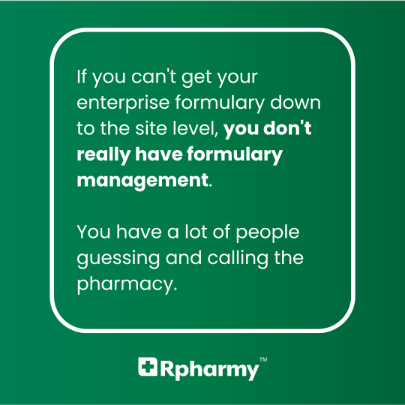
One pharmacy leader described it this way: if you can't get your enterprise formulary down to the site level, you don't really have formulary management. You have a lot of people guessing and calling the pharmacy.
That's not a technology problem, though technology is part of the answer. It's a communication infrastructure problem. A lot of health systems are dealing with this, whether they can recognize the root of it or not.
The good news is that pharmacy leaders who have been trying for years to get resources and attention for formulary management are finding that the consolidation conversation is helping move it along. When a CFO sees what unmanaged formulary variability costs in non-formulary purchasing, missed therapeutic interchanges, and prior authorization gaps, ears perk up and funds may come available.
Formulary has always been exciting (really, it has). It just took this latest trend of consolidation to remind everyone why.
Like I mentioned at the beginning, I’ve been at this a long time and am here to help. Our ongoing Formweb in 15 (minutes) webinar series shares how our clients are handling their formulary, touching on subjects like file management, drug restrictions and more. Check it out here: https://www.rpharmy.com/formweb-in-15-webinar-series