

Poor formulary communication costs health systems money in ways that rarely show up as a single line item, which is exactly why the problem persists as long as it does.
 Formulary gaps are common, and the financial cost of those gaps is harder to see than most leaders expect. The losses tend to be distributed across purchasing, revenue cycle, and clinical operations rather than sitting in one place where someone can point to them.
 Where does the money actually go?
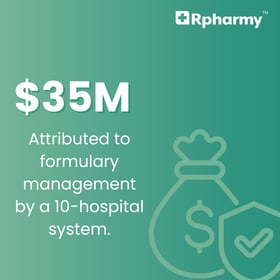
The most direct losses come from non-formulary purchasing. When clinicians can’t easily find or understand formulary restrictions, they default to what’s familiar or what’s requested, and purchasing follows. A 10-hospital system we work with traced $35 million in savings back to one change: their formulary became accessible, accurate, and consistently applied across every site. When that happened, therapeutic interchanges got followed, clinicians stayed within contracted products, and non-formulary requests got flagged before they became purchasing habits. The formulary was doing its job, and the savings came with it.
Prior authorizations are another significant leak. We had a client whose eye clinic had been dispensing a high-cost drug for months without confirming prior authorization before a single dose went out. When someone finally looked, revenue cycle had never received a PA for any of those claims. The PA requirement was in the formulary. It just wasn’t visible at the moment the dispensing decision was being made. By the time anyone caught it, the claims were already in the rearview mirror.
Biosimilar contract compliance is a growing version of the same problem. When buyers can’t easily see which manufacturer a health system is contracted with, they order from what’s familiar. The difference between the contracted product and the non-contracted one may seem small per unit, but across a health system managing dozens of biosimilars across multiple sites, it compounds quickly.
What standardization looks like at scale
One of our clients came to us managing a centralized purchasing operation across 40 hospitals and more than 500 clinics. Their team had gone from 42 buyers down to 10 as part of a centralization effort, which meant every one of those buyers needed to be working from the same information at the same time.
What they found was that Formweb became their first line of defense before purchasing anything. Before a drug went into their inventory system, their team would go to the formulary first: is this on formulary? What are the restrictions? Is there a prior authorization requirement? What service lines is this approved for? That workflow change shifted how their buyers operated, because the information was there when they needed it rather than sitting somewhere that required a call to pharmacy to find.
Standardization at that scale is less about technology and more about whether everyone is looking at the same source of truth when they make decisions. When they are, the financial impact tends to follow.
Putting a number on it
Honestly, it is hard to do with precision, and we’d rather be straight about that than overstate it.
What we can say is that the organizations doing this well are looking at it from multiple angles at once:
- What are we spending on non-formulary drugs we shouldn’t be purchasing?
- What claims are getting denied because PA requirements weren’t confirmed at the point of dispensing?
- Where are our therapeutic interchange compliance rates falling short of what we negotiated?
- Are our buyers ordering from contracted manufacturers, or defaulting to what’s familiar?
One pharmacy leader put it simply: if you could achieve even 1% savings through standardization on a $900 million drug budget, that’s $9 million. Ten percent is $90 million. Most organizations we talk to are not anywhere close to capturing what’s available to them, not because the savings aren’t there, but because the formulary communication infrastructure isn’t in place to make it visible.
Bottom line: the organizations treating formulary management as a financial function, not just a clinical one, are finding the money that others are leaving on the table.
If you want to see what this looks like in practice, you can explore Formweb at www.formweb.com/demo, no signup required.