---
title: "Healthcare Affirmation Series: Audrey Kostrzewa, PharmD, MPH, BCPS"
description: This blog highlights the vital work to improve patient and healthcare worker safety that Audrey Kostrzewa, PharmD, MPH, BCPS, is doing as a professor and pharmacist.
image: https://www.rpharmy.com/hubfs/Safety%20First%20Blog%20Cover%20Photos_Audrey%20Blog.png
---
[
](https://www.rpharmy.com/)
## Safety First Blog
# Healthcare Affirmation Series: Audrey Kostrzewa, PharmD, MPH, BCPS
Posted by [Caroline McBreen](https://www.rpharmy.com/blog/author/caroline-mcbreen) on Jan 21, 2026 3:42:18 PM

Find me on:
[LinkedIn](https://www.linkedin.com/in/carolinemcbreen)
## How Can We Transform Outpatient Pharmacy Safety Through Data, Culture, and Accountability?
In this installment of our Healthcare Affirmations series, we're spotlighting Audrey Kostrzewa, PharmD, MPH, Professor of Pharmacy Practice and Medication Utilization Pharmacist, whose dual role in academia and health systems bridges the gap between teaching the next generation and tackling one of pharmacy's most pressing challenges: systematic safety in outpatient settings.
Audrey was nominated for our Healthcare Affirmation series by Larry Selkow, the Immediate Past President of the Southern California Public Health Association. Along with Audrey, he was an author of "[Improving Public Health by Advancing a Multicomponent Approach to Increasing Prescription Dispensing Safety in U.S. Outpatient Pharmacies](https://www.apha.org/getcontentasset/e05b4298-e149-43b3-bbd4-b714ed6cc9f8/7ca0dc9d-611d-46e2-9fd3-26a4c03ddcbb/20247pharmacyerrorsfinal125.pdf?language=en)," a policy statement on dispensing errors in outpatient pharmacies due to understaffing and intense working conditions.
Larry said, "Audrey is an amazing public health professional, dedicated to patient safety. She was the lead author on a policy statement on dispensing errors in community pharmacies. This policy statement was adopted by the American Public Health Association in 2024 at their annual meeting. Audrey recently received the Sustained Contributor Award for the Pharmacy Section of the American Public Health Association."
A huge thanks to Larry for taking the time to nominate Audrey! We love celebrating the safety champions among us in the healthcare industry and are thrilled to share Audrey's story.
#### **THE GROUNDBREAKING DISPENSING ERROR POLICY**
Audrey's passion for advocacy led her to co-author a groundbreaking policy for APHA: "[Improving Public Health by Advancing a Multicomponent Approach to Increasing Prescription Dispensing Safety in U.S. Outpatient Pharmacies](https://www.apha.org/getcontentasset/e05b4298-e149-43b3-bbd4-b714ed6cc9f8/7ca0dc9d-611d-46e2-9fd3-26a4c03ddcbb/20247pharmacyerrorsfinal125.pdf?language=en)."
The three-year project involved seven authors, including Larry, rigorous peer review, open hearings, and organizational voting. The result? A 29-page, 75-reference policy brief approved in October 2024 and published in January 2025.
"It's not brief," Audrey laughs, "but it serves as the organization's evidence-based stance on the topic."
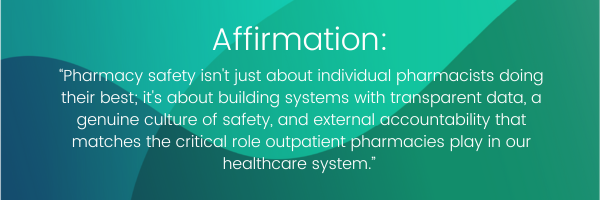
The policy addresses workforce issues that have made headlines: walkouts, strikes, even suicides and deaths in pharmacy, but goes deeper. "We wanted to focus on the systematic nature of errors. It's a systematic issue, and it requires systematic solutions."
#### **THREE CRITICAL PILLARS FOR OUTPATIENT PHARMACY SAFETY**
The policy identifies three critical areas that must be addressed to improve outpatient pharmacy safety:
##### **1. Data and Transparent Error Reporting**
- Outpatient pharmacies, especially corporate chains, operate with virtually no external error reporting requirements.
- Unlike hospitals accredited by Joint Commission or monitored by CMS, community pharmacies are "in the wild wild west."
- "We don't even know what's going on. We need data to address the problem," Audrey explains.
- Reporting systems must not add more burden to already-stretched pharmacy staff.
##### **2. Safety Culture**
- Individual pharmacists care deeply about safety; that's why they entered the field.
- Corporations and companies must prioritize safety, not just profit.
- A genuine culture of safety must permeate every level of the organization.
##### **3. External Accountability**
- Outpatient pharmacies serve far more patients than hospitals, including people who just walk in.
- The number of patient touches in outpatient settings is exponentially higher than in hospitals.
- Yet these pharmacies face far less scrutiny than accredited health systems.
- External accountability from regulatory bodies is essential.
"It's an anomaly that community-based outpatient pharmacies don't have the same scrutiny as hospitals and health systems," Audrey says. "And that is where the vast majority of people in our country get healthcare."
Audrey's role at APHA is expanding, as she now serves on the APHA Pharmacy Section Governing Council, with the responsibility to vote on future policies.
#### **THE PATH THAT LED HERE: FROM GERIATRICS TO SYSTEMATIC SAFETY**
So how did Audrey become a leading voice in outpatient pharmacy safety?
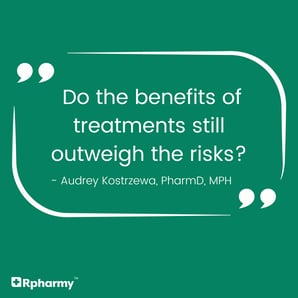She didn't expect to love drug information. Growing up in Minnesota and earning dual degrees from the University of Iowa (PharmD and MPH), her passion was ambulatory care and geriatrics, meeting patients where they are, managing chronic diseases, and asking the critical question: Do the benefits of treatments still outweigh the risks?
After completing an ambulatory care residency at Froedtert & the Medical College of Wisconsin, she helped establish the health system's first geriatric pharmacy rotation with deprescribing as a cornerstone. Then came an unexpected opportunity: a drug information specialist position at Concordia University Wisconsin. Audrey hesitated, but 13 years later, she wouldn't trade it. "What I really wanted was to work with people and create connection, and teaching provides that for me," she says.
Today, Audrey splits her time between teaching at Concordia University Wisconsin School of Pharmacy three days a week and working as a medication utilization pharmacist at Froedtert & the Medical College of Wisconsin two days a week. She teaches medical literature evaluation, servant leadership, and public health, and lectures on REMS programs, formulary management, and drug shortages, all focused on medication safety. She’s also launching a [Masters of Public Health (MPH) program](https://www.cuw.edu/academics/programs/public-health-masters/index.html) at Concordia University Wisconsin.
Her teaching philosophy centers on lifelong learning. "Your degree is like a new car off the lot; it immediately loses value if you don't know how to keep your skills up," she tells students. She graduated roughly 15 years ago, and entire drug classes exist today that didn't exist then.
In her practice role, Audrey manages formulary decisions, reviews vaccine recommendations from ACIP and CDC, and oversees all REMS programs for the health system. She also precepts students and residents at every level, from P1 students learning drug information databases to PGY-2 residents publishing research. "I describe our team as a jack of all trades, master of some," she says, loving the chance to explore everything from CAR-T therapy to medications compatible with feeding tubes.
#### **WHAT DRIVES AUDREY'S PASSION?**
When asked about her favorite part of the day, Audrey lights up talking about those side conversations—before or after class, in the hallway, during preceptorship.
"Light bulb moments," she says. "Those happen in teaching and in practice."
Whether it's a student excited about a topic, a resident developing their first continuing education presentation, or a colleague engaging in preceptor development, Audrey thrives on learning with others.
"I like being with students, but I also enjoy learning with other people. That's probably one of my favorite things."
#### **CLOSING REFLECTION**
At Rpharmy, we believe medication safety improves when we address systematic issues, not just individual errors. Audrey's story reminds us that real change requires data transparency, cultural commitment, and accountability structures, and that the people on the frontlines deserve systems designed to support their success, not compound their burden. Be sure to check out the APHA policy on medication dispensing safety.
And, as always, if you or someone you know should be celebrated in our Healthcare Affirmation series, fill out the [form](https://share.hsforms.com/2Ghi9TlZiRye6kzaM9O-zOA3xo7n) and we'll do the rest!
Topics: [Rhazdrugs](https://www.rpharmy.com/blog/tag/rhazdrugs), [Policy](https://www.rpharmy.com/blog/tag/policy), [USP <800>](https://www.rpharmy.com/blog/tag/usp-800), [Technology](https://www.rpharmy.com/blog/tag/technology), [NIOSH](https://www.rpharmy.com/blog/tag/niosh)
## New Name
### Same Company You Trust
Rpharmy has a suite of products to meet the diverse needs of our customers.
[](https://cta-redirect.hubspot.com/cta/redirect/6609875/a0ac2f07-0b34-478c-831b-7c86eb11a2bf)
### Subscribe to our blog!
### Posts by Tag
- [Rhazdrugs (149)](https://www.rpharmy.com/blog/tag/rhazdrugs)
- [Policy (144)](https://www.rpharmy.com/blog/tag/policy)
- [USP <800> (144)](https://www.rpharmy.com/blog/tag/usp-800)
- [Formweb (122)](https://www.rpharmy.com/blog/tag/formweb)
- [Technology (41)](https://www.rpharmy.com/blog/tag/technology)
- [NIOSH (21)](https://www.rpharmy.com/blog/tag/niosh)
- [News (20)](https://www.rpharmy.com/blog/tag/news)
- [Company (11)](https://www.rpharmy.com/blog/tag/company)
- [Formulary (9)](https://www.rpharmy.com/blog/tag/formulary)
- [COVID (3)](https://www.rpharmy.com/blog/tag/covid)
- [Insider (3)](https://www.rpharmy.com/blog/tag/insider)
- [Joint Commission (2)](https://www.rpharmy.com/blog/tag/joint-commission)
- [PPE (1)](https://www.rpharmy.com/blog/tag/ppe)
[See all](https://www.rpharmy.com/blog/healthcare-affirmation-series-audrey-kostrzewa-pharmd-mph-bcps#)
### Recent Posts
PO Box 340220
Austin TX 78734
info@rpharmy.com[tel:+18004671907](tel:+18004671907)
[](https://www.rpharmy.com/blog/womanownedbusiness)
© 2026 Rpharmy. All Rights Reserved. [Privacy Policy](https://www.rpharmy.com/blog/healthcare-affirmation-series-audrey-kostrzewa-pharmd-mph-bcps#)
```json
{
"@context" : "https://schema.org",
"@type" : "BlogPosting",
"author" : {
"@type" : "Person",
"name" : "Caroline McBreen",
"url" : "https://www.rpharmy.com/blog/author/caroline-mcbreen"
},
"dateModified" : "2026-01-23T13:38:37.271Z",
"datePublished" : "2026-01-21T21:42:18.000Z",
"headline" : "Healthcare Affirmation Series: Audrey Kostrzewa, PharmD, MPH, BCPS",
"image" : [ "https://www.rpharmy.com/hubfs/Safety%20First%20Blog%20Cover%20Photos_Audrey%20Blog.png" ],
"mainEntityOfPage" : {
"@id" : "https://www.rpharmy.com/blog/healthcare-affirmation-series-audrey-kostrzewa-pharmd-mph-bcps",
"@type" : "WebPage"
},
"publisher" : {
"@type" : "Organization",
"logo" : {
"@type" : "ImageObject",
"url" : "https://www.rpharmy.com/hubfs/Foundation%2020/Signatures/rpharmy-logo.png"
},
"name" : "Rpharmy"
}
}
```